
Award Won!

Best Social Media Crowdsourcing Game
BattleBottle: Drone Commander (SGS&C Europe Winner)

Organization:

BattleBottle

Dev Category:

Release Year:

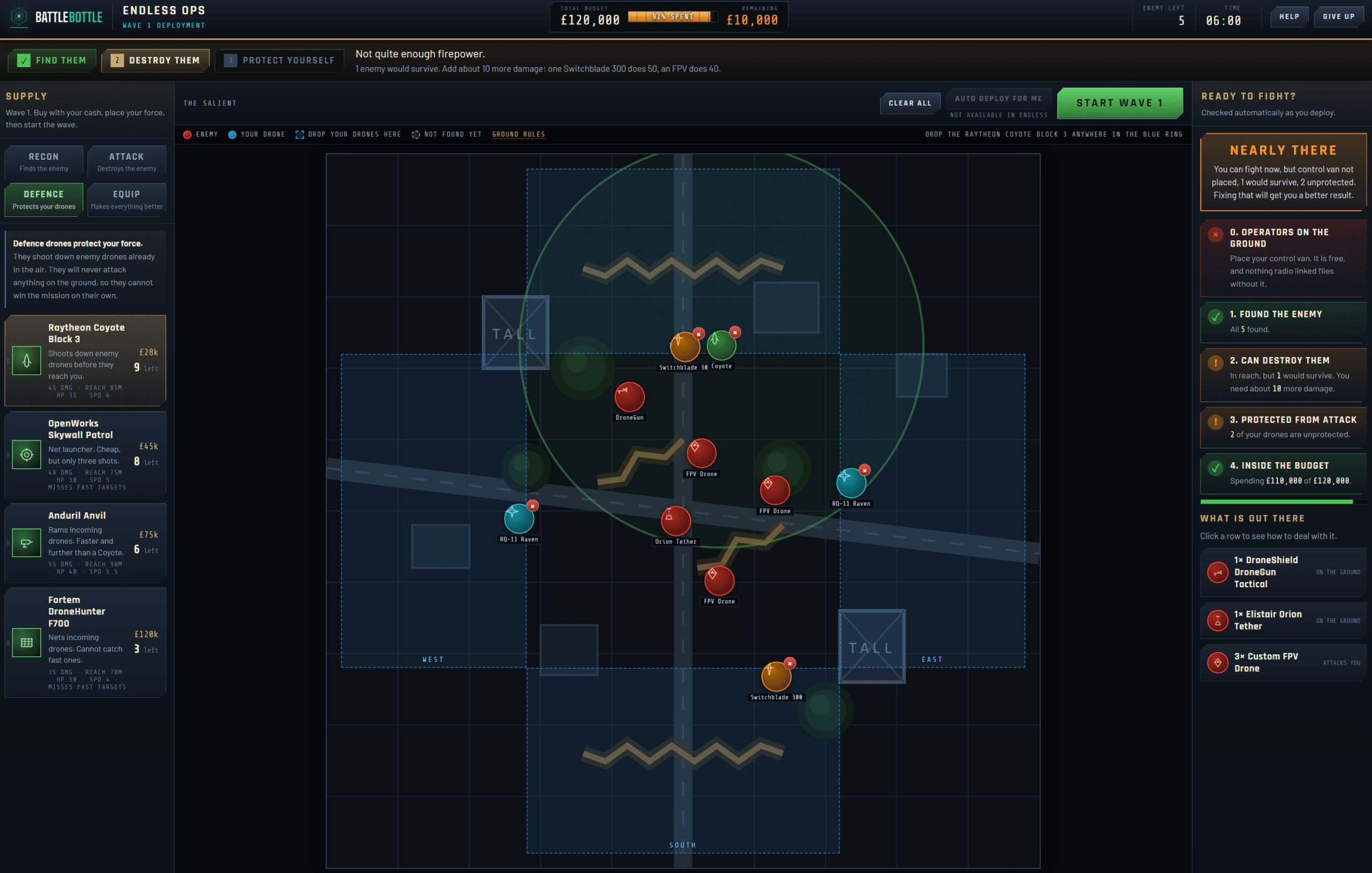
BattleBottle: Drone Commander is a single-player planning game about winning a counter-drone skirmish for the least money. The player never flies anything. They read a short briefing, choose which drones and counter-drone systems to bring, drag each unit onto the map, press Fight, and watch the plan resolve with no further input. The whole game is the decision made before the shooting starts.

Every unit is a real system doing its real job at a realistic price: RQ-11 Raven, Skydio X2D, ScanEagle and Black Hornet scouts; Switchblade 300 and 600 loitering munitions and FPV strike drones; Coyote and Anvil interceptors; Skywall and DroneHunter net systems; DroneGun and Silent Archer jammers; an MPU5 mesh radio; an Orion tethered power station; and the control van the whole force depends on. The couplings are the ones that matter in the field. Nothing engages what recon has not found. Nets cannot catch a fast FPV. Jamming does nothing to an autonomous airframe. Dug-in positions take a third less damage. Lose the van and every radio-linked drone drops, and the same is true for the enemy’s van.

The engine is fully deterministic. The same layout against the same mission always produces the same battle, so a loss is a plan the player can fix, never bad luck. Three missions take the player from a coached find-and-strike on open ground to an uncoached combined layout on an industrial site, and Endless Ops then runs escalating seeded waves with cash, salvage and survivors carrying over. Every mission is scored like golf: one star to clear it, two to clear it at or under the par cost, three to do it without losing a unit. After every fight the game shows a strength-over-time chart with the decisive moment marked, a loss ledger, a cost-exchange ratio, and a plain-language reason for the result followed by the fix.

The game is the consumer end of BattleBottle’s dual-use platform. In the full product every completed game is a logged simulation that helps fine-tune the in-house model behind our government-facing tactical advisor.

Game Overview

The game teaches the decision chain behind a drone and counter-drone engagement, at the level a junior leader or new operator needs before planning a real one. A player who finishes the three missions can do seven things they could not do before, and each one is observable in play.

1. Find before you fight. Nothing engages an enemy that recon has not detected. Players learn to put sensor coverage over the threat area first, to size it against detection radii that never cover the whole site, and to account for trees and buildings that break line of sight.

2. Match the effector to the threat. Loitering munitions for ground positions, interceptors for incoming drones, nets only for slow targets, jammers only against radio-linked airframes. Players learn to read a unit card (damage, reach, speed, hit points) and to check that combined damage exceeds target hit points, including the one-third saving a trench gives a dug-in position.

3. Layer the defense. Scouts and strike drones are fragile; defense protects but never advances. Players learn to put interceptors between the threat and everything fragile, and to count who is still exposed before committing.

4. Protect the single point of failure. The control van is free and must be placed; if it dies every radio-linked drone drops. The enemy’s van works the same way, which makes it the most valuable target on the map. Players learn dependency thinking and target prioritization.

5. Win on cost, not just outcome. Every mission has a par cost and every result shows value destroyed per pound spent. Players learn the attrition arithmetic of drone warfare: a 500 pound FPV that does 40 damage, and a 32 million pound Reaper that is in the catalog and never issued.

6. Read the ground. Roads, tree cover, tall blocks and trenches change detection, movement and damage for both sides.

7. Plan, review, revise. Because nothing is random, players learn to debrief a result, change one variable and test the hypothesis, which is the same cycle a planning team runs in a rehearsal of concept drill.

Every mission asks the same question with a harder answer: clear the site, keep your force alive, and do it for the least money.

Mission 1, Find and Strike: Four enemy positions hidden on open ground. Find them with scouts whose circles never cover the whole site, then destroy them, inside a 220,000 pound budget against a 100,000 pound par.

Mission 2, Hold and Clear: The enemy fights back with attack drones launched in waves, their FPVs are too fast for nets, and their jammer is dug into a trench. Shield first, then scout, then strike, against a 220,000 pound par on a 480,000 pound budget.

Mission 3, Destroy Your Enemies: No coaching. Ten to fifteen units on an industrial site, something heavier than an FPV reported, and a control van on both sides that decides everything. Beat a 450,000 pound par on 900,000.

Endless Ops: Seeded waves that escalate, wave pay and salvage that carry over, one reinforcement from a rotating offer of three, survivors that carry their damage. The challenge is how many waves you can hold.

Inside every mission the challenge is a budget puzzle under a clock: scouts are expensive and short-sighted, strike drones are consumed when they hit, nets miss fast targets, interceptors protect but never advance, and the most valuable target on the map is the one you have to find first.

Primary: the government and defense training audience. Junior leaders, new UAS and counter-UAS operators, cadets in pre-entry programs and planning staff who need to understand a drone and counter-drone engagement as a resource problem before they plan a real one. The game works as a first-week induction tool, a ten-minute refresher, and a shared reference when a planning team wants to talk through a layout. Our defense-facing product grows out of the same engine, so what a recruit learns here is the same logic a staff officer later sees in the tactical advisor.

Secondary: young people from 12 upwards who are interested in defense, aviation or strategy, as an engagement route into drone operations and into the STEM skills underneath the game: coverage geometry, budgeting, systems dependency and decision making under constraint. A pilot with the UK air cadet community is being set up with this audience in mind.

Third: the general strategy-game public through the consumer release, which is where training data for the advisor comes from at scale.

Age suitability: the presentation is an abstract, top-down map of icons, circles and lines. There are no characters, no depicted people, no gore and no graphic content, and the language is plain throughout. It meets the 12 plus baseline.

The game assesses the player the way a planner is assessed: did the plan work, what did it cost, and what did it lose.

Summative, per mission: site cleared or not; enemy destroyed out of total; own units lost out of deployed; spend against par and budget; cost-exchange ratio. Stars are the grade: one for the outcome, two for the outcome at or under par, three for the outcome under par with no losses. The best grade per mission is kept for the session.

Formative, during deployment: the four-question readiness panel is a continuous assessment of the plan before commitment, with numbers (how many found, how many would survive and by how much damage, how many exposed, how far over par). It assesses the plan, not reflexes.

Diagnostic, after the fight: the lessons engine inspects the battle record and names the specific failure against the learning objectives: no recon brought, a named enemy never found, strike drones exhausted with targets still in reach, units lost with nothing defending, over par, over budget, control van lost, out of time. Each is paired with its correction.

Endless Ops assesses sustained performance: waves held, enemy destroyed across the run, cumulative spend and exchange ratio, and a best-wave record for the session.

Because nothing is random the assessment is reliable. The same plan scores the same way for every player, two players’ plans can be compared directly, and a player’s improvement between attempts is entirely attributable to the player.

Game Specs

Game Engine
Operating System
Platform

Game Video

Play the video below to learn more about BattleBottle: Drone Commander (SGS&C Europe Winner)