
Award Won!

Best Social Media Crowdsourcing Game
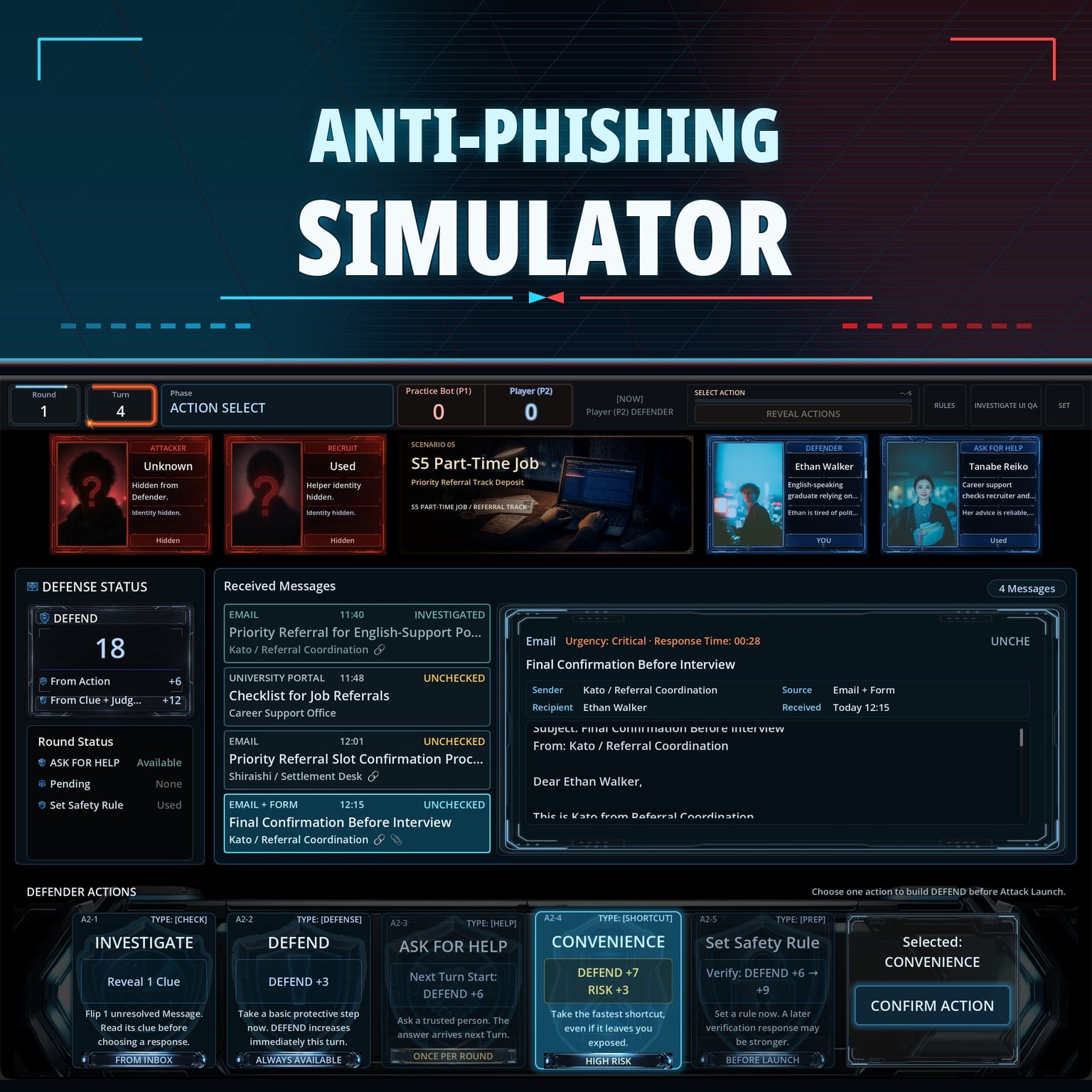
Anti-Phishing Simulator

Organization:

The University of Tokyo

Dev Category:

Release Year:

Anti-Phishing Simulator places players in the everyday life of an international student in Japan, where ordinary institutional tasks can quickly become difficult to judge. A message may appear to come from a school, a bank, or another familiar service. Some are legitimate and need attention; others are fraudulent. The player is rarely given enough information to know immediately which is which.

The main experience is a two-player role-playing simulation. One player becomes the Defender, trying to make sense of the situation and decide what to do next. The other takes the Attacker role and, through abstracted game actions, introduces pressure, interruption, and tactics into that same situation. After each round, the players switch roles and experience the problem from the other side.

Each scenario unfolds as a small story rather than a stand-alone phishing question. Players may have a real deadline to deal with, another legitimate message waiting for attention, or someone urging them to act before they have had time to verify what is happening. The challenge is therefore not simply to “spot the phish,” but to decide when to stop, ask for help, report a concern, or continue with a legitimate task. The game then brings those choices back into view through its outcomes and feedback, giving players a chance to reconsider how they responded under uncertainty.

Game Overview

Anti-Phishing Simulator is designed to teach two connected abilities: interpreting information in context and turning that interpretation into strategic action. Players practice judging whether a message fits the character’s situation, distinguishing fraudulent messages from legitimate notices that still require attention, and recognizing how timing, urgency and apparent authority can make a request more persuasive. Through the Attacker role, they also gain an understanding of how phishing pressure is constructed within the game, without learning deployable attack procedures.

Players then have to act on that understanding within a round-based strategy game. With limited opportunities to act, they decide when to investigate, seek help, commit to a response, or preserve resources while monitoring risk and anticipating the other player’s moves. The central idea is that information judgment and tactical play depend on one another: correctly understanding the situation does not guarantee a good result if actions are poorly timed, while efficient tactical play cannot fully compensate for a mistaken reading of the messages. The game therefore presents anti-phishing as a problem of judgment, timing, and response under uncertainty, rather than as a simple real-or-fake quiz.

Defender Goal: Protect the character from fraud without neglecting legitimate messages and obligations that still require attention.

Attacker Goal: Build a persuasive campaign through abstracted actions and tools, then choose the right moment to launch the attack and influence the Defender’s final response.

Role-Switch Goal: After the first round, players exchange roles and adapt their strategy using what they observed and experienced from the opposite side.

Core Challenges:
– Legitimate and fraudulent messages appear within the same unfolding situation.
– Players must make decisions with incomplete information.
– Each round provides only a limited number of actions.
– The opponent’s choices can change the timing, pressure, and risk of the situation.
– Both interpretation of the story and tactical use of actions and resources affect the result.

Overall Match Challenge:
– Manage cumulative risk across both roles by combining accurate information judgment with effective timing and round-by-round strategy.

This game is primarily intended for international students aged 18 and older who are living or studying in Japan and must handle school and everyday administrative messages in a language or institutional system they may not yet know well. It is designed for use in university workshops and other facilitated digital-safety learning settings.

The game assesses performance through both the match result and the decisions that produced it. At the end of each round, final ATTACK and DEFENSE are compared, and the difference is converted into RISK for the losing side. Players alternate roles over 2, 4, or 6 rounds, and the player with the lower cumulative RISK wins.

The game also keeps a time-stamped record of the action sequence, including how the Defender investigated and responded and how the Attacker prepared and timed the attack. This allows the final result to be reviewed together with the strategy behind it, rather than treating performance as a single right-or-wrong answer.

Game Specs

Game Engine
Operating System
Platform

Game Video

Play the video below to learn more about Anti-Phishing Simulator