
Award Won!

Best Social Media Crowdsourcing Game
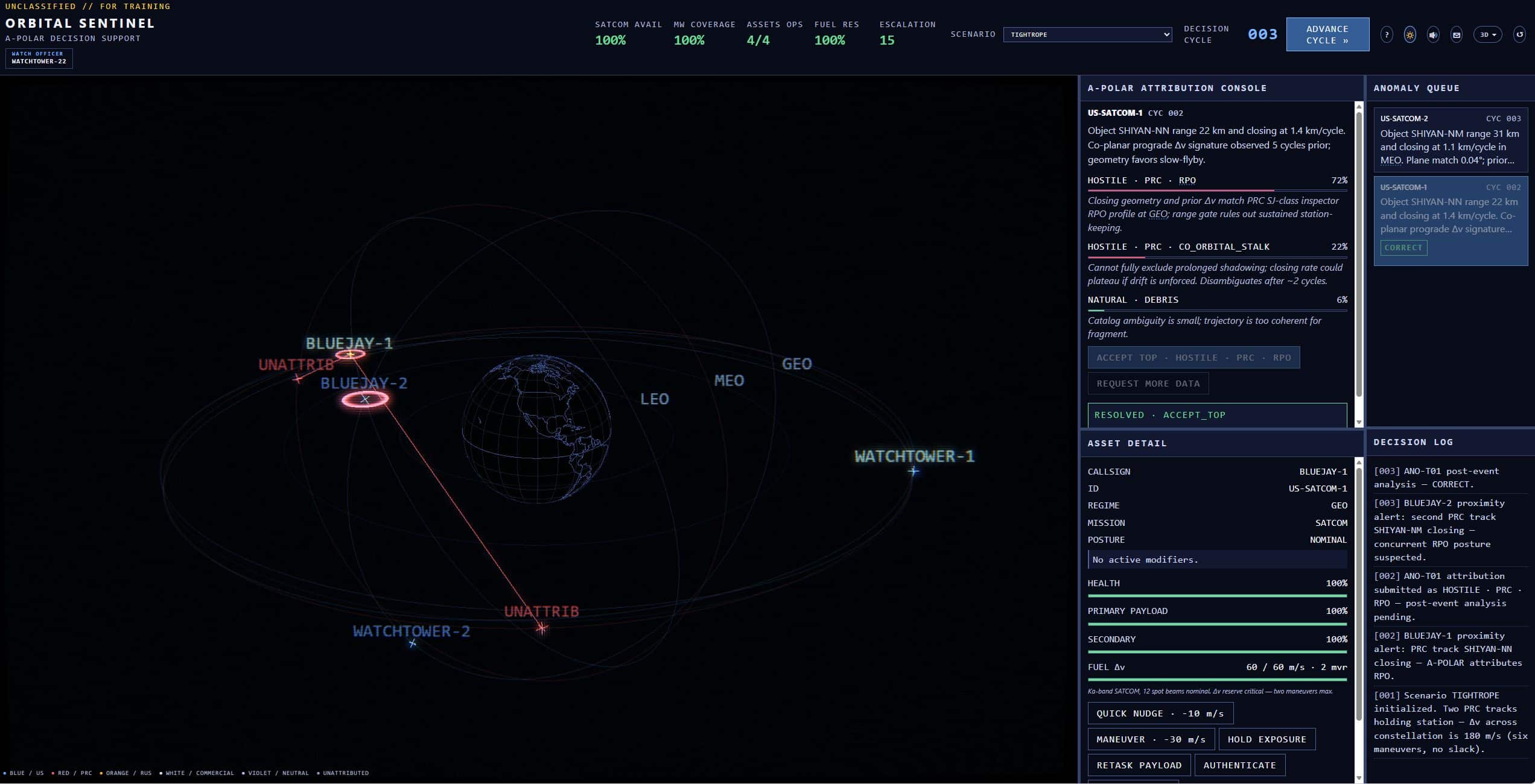
Orbital Sentinel

Organization:

JANUS Research Group

Release Year:

Orbital Sentinel is a browser-based space-domain-awareness training wargame in which you command a U.S. satellite constellation under simultaneous adversary probing and space weather, and must attribute each anomaly as hostile action or natural cause — treating the A-POLAR AI console’s ranked hypotheses as advice rather than answers — before spending scarce fuel and posture on a response.

Player’s will follow a loop in each scenario.
SENSE — anomalies surface from sensors across the constellation
ATTRIBUTE — A-POLAR ranks hypotheses with confidence; player accepts, overrides, or requests additional analysis. Submission is marked PENDING until truth reveals next cycle
DECIDE — quick nudge, maneuver, retask payload, or shift posture across BLUEJAY (SATCOM), WATCHTOWER (missile-warning), and HAWKEYE (LEO ISR) assets
RESOLVE — adversary acts, mission scores update, prior attributions reveal CORRECT/INCORRECT

At the end of the scenario the debrief grades the run with a composite letter grade.

Eighteen scenarios across four pedagogical categories. The picker groups them under TUTORIAL / TURN-BASED LESSONS / REALTIME LESSONS / CAPSTONE optgroups, and locked entries appear with a 🔒.

Unlock model (B or better passes the bar):

Tutorials unlock sequentially — the basic tutorial is always playable; the realtime tutorial unlocks once the basic one is passed.
Turn-based lessons all open at once after the basic tutorial is passed (free-pick sandbox).
Timed lessons + capstones follow a linear chain — each requires a passing grade on the previous entry in the chain.

Game Overview

The main thing taught is the decision cycle a constellation operator will need to learn. Sense -> Attribute -> Decide -> Resolve. Which is repeated over and over during each scenario.

The single skill everything else serves is calibrated reliance on AI decision support — deciding whether to trust, override, or pay to improve an automated attribution when the truth isn’t available yet. Essentially A-POLAR advises, “You decide.”

Each scenario teaches a different potential trap a constellation operator may face below are some examples:
PHANTOM TRACK: A-POLAR’s top hypothesis is wrong, and applying its recommended jam mitigation makes things worse (switching to a GNSS the spoofer also broadcasts on). Teaches: reject the cached hypothesis when evidence doesn’t fit.
SPACE JAM: Confidence numbers stay flat at 0.55 across three events while the evidence pattern moves. Operators who don’t read the decision log keep picking the wrong source. Teaches: do the temporal analysis yourself.
SILENT HANDOFF: Single-event upset is the plausible-but-wrong cause (0.48 vs the true cyber at 0.39), with an orbital inspector as a decoy. Teaches: the threat surface includes the ground segment; not all attacks come via RF.
SILENT ORBITS: Eight natural events to three hostile. Punishes the paranoid operator who treats every ambiguity as an attack and burns Δv on phantoms. CASCADE: An unavoidable loss that still demands action — harm mitigation on a doomed satellite is free and prevents a downstream collision. Teaches: always act to reduce downstream harm, even on a write-off.
SOLAR REVERSAL: Introduces HOLD EXPOSURE, the counter-reflex to evading: sometimes the correct move is to press an advantage rather than defend. Evading is scripted to let the adversary return.
AURORA WATCH: The adversary times its action to a real storm. Both are real; you can dismiss neither. Teaches: read timing as evidence of intent. THERMOSPHERIC TIDE: Cumulative small flares, invisible at any single moment. Attacks the assumption that only the big event matters. TIGHTROPE: Six maneuvers of fuel, four required. One wasted burn fails the run. VARIABLE DUSK: Seeded random draw from a template pool — exists specifically to defeat memorization.

Supporting tradecraft
Cost-calibrated action selection. Every response has a price, and picking the right response is a distinct skill from diagnosing correctly: QUICK NUDGE at 10 m/s but only when the deadline is ≥3 cycles out, MANEUVER at 30 m/s and always effective, AUTHENTICATE for spoofing versus RETASK for jamming versus REVOKE CREDENTIALS for cyber. The debrief measures whether you reached for the right verb, and the only prescriptive coaching in the whole game fires when a full maneuver did a nudge’s job.

Anticipatory sensor tasking. Setting an asset to OBSERVING sharpens future A-POLAR confidence on it — pre-positioning is mechanically rewarded. DEFENSIVE mitigates dazzling but bleeds 5% mission score per cycle, so “don’t hold indefinitely” is a taught judgment.

Paying for certainty. REQUEST MORE DATA boosts truth-aligned confidence 50% but costs a full cycle and is one-shot per anomaly — an explicit price on reducing uncertainty.

Scope of authority. Commercial and neutral tracks appear on the picture but are never yours to mitigate or attribute.

Space domain knowledge is taught in context: Space Weather terms such as Coronal Mass Ejections, Energized Charged Particles, orbits (Low Earth, Medium Earth, Geostationary, High Earth) hostile actions such as Dazzle, Jamming, essentially a total of 45 glossary terms auto-linked on first use in any panel. The player will learn the vocabulary as they play through scenarios to better deal with traps: jamming, spoofing, and cyber threats.

The goal is to pass every scenario with the highest score/grade possible and advance from cadet to sentinel prime.

Primary audience are those on track to manage satellite constellations, but anyone can play this game and learn about threats to space based assets.

The game measures Attribution Accuracy, Threat Mitigation, Resource Availability, Fuel Discipline for each scenario. Providing a grade based on users actions in the scenario.

Game Specs

Game Engine
Operating System
Platform