
Award Won!

Best Social Media Crowdsourcing Game
D.R.E.A.D. (Drone Readiness Education Assault Defense)

Organization:

USAF Academy

Dev Category:

Release Year:

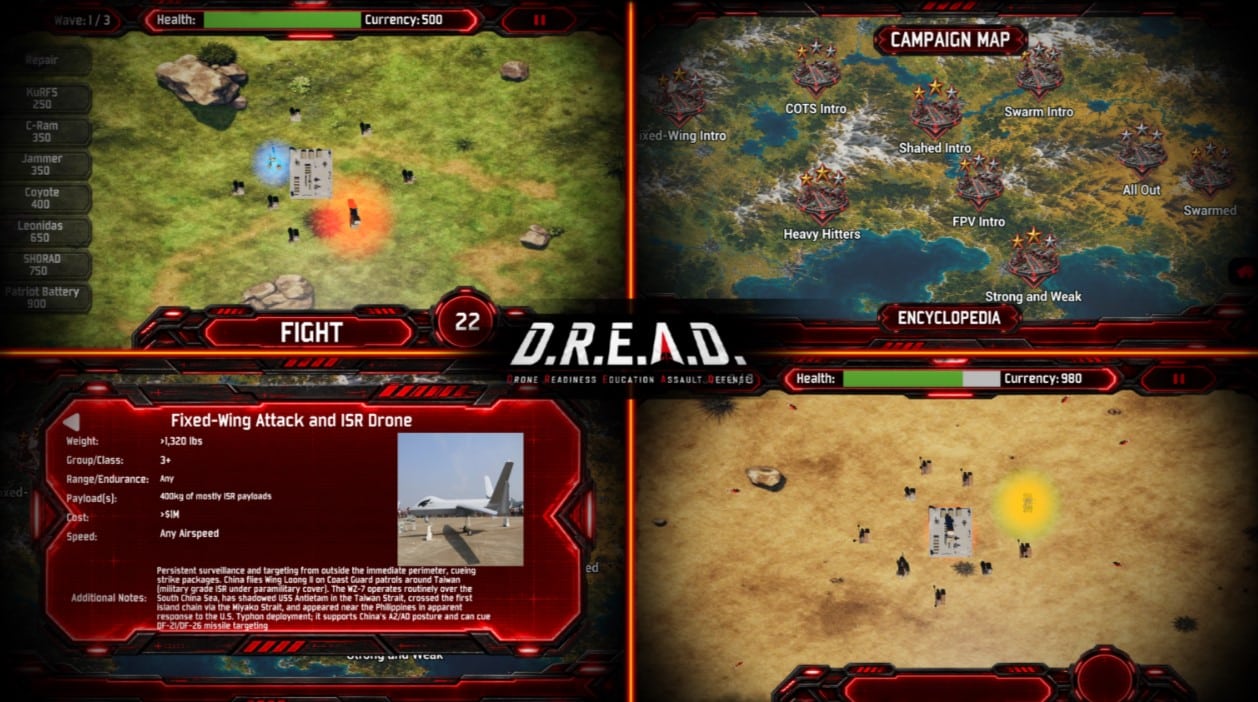
D.R.E.A.D. (Drone Readiness Education Assault Defense) is an educational Counter-Unmanned Aerial System (C-UAS) tower-defense wargame developed by cadets at the U.S. Air Force Academy for the 2026 Cadet Summer Research Program (CSRP). By interpreting the presented threat intelligence, constructing a layered defense, selecting and positioning defensive capabilities, and managing limited resources, the player defends a critical asset against an escalating series of UAS attacks.

Representative threats include commercial quadcopters, first-person-view attack drones, one-way attack aircraft, swarms, and larger fixed-wing systems, whereas defensive capabilities include sensing, kinetic, directed-energy, and electronic-warfare systems. Each capability differs by range, cost, effectiveness, and limitations; thus, various aspects of cost-exchange and tradeoff decisions can be explored. While high-cost interceptors may be inefficient against low-cost threats, some capabilities have certain limitations that force the player to consider using defensive capabilities in combination.

Built from current C-UAS research and informed by systems engineering, human factors, and cognitive science principles, D.R.E.A.D. offers repeated decision points grounded in technical content and encourages players to consider layered defense, resource management, and adjustments to defensive strategy as threats evolve. D.R.E.A.D. is a challenging yet accessible wargame that encourages players to examine tradeoffs and opportunity costs as they make decisions about defending a critical asset against UAS attacks.

Game Overview

D.R.E.A.D. emphasizes decision-making in a strained C-UAS environment and offers the player multiple ways to engage. The player must recognize patterns, identify UAS threats, and differentiate among them based on size and class, speed, range or endurance, payload, cost, and other factors. Similarly, the player must examine and compare available defensive capabilities based on their roles, ranges, acquisition and per-engagement costs, and other limitations. Although the threats and defensive capabilities are representative rather than exact models of operational systems, they are grounded in current research. Representative threats include commercial quadcopters, first-person-view attack drones, one-way attack aircraft, swarms, and larger fixed-wing systems. Defensive capabilities include sensing, kinetic, directed-energy, and electronic-warfare systems. Information is presented in-game to help players recognize patterns and compare the characteristics, strengths, and limitations of both threats and defensive capabilities.

Beyond identifying the available capabilities, the player must apply this knowledge to construct an effective layered defense by acquiring and placing capabilities based on their effectiveness, range, cost, and other information presented. The player must also identify effective capabilities, balance them to maximize overall effectiveness, allocate limited resources, and adapt the defense in response to an evolving situation. These tasks incorporate human factors elements such as pattern recognition, situational awareness, information processing, workload management, and decision-making under increasing time pressure. In doing so, the player develops an understanding of the need to balance capabilities with their individual strengths and weaknesses and to adapt to changing UAS threats.

The player must survive the incoming UAS attacks to complete the mission and protect the critical asset. In doing so, they must select from the available capabilities to construct an effective layered defense considering the range, role, cost, and other information presented and place them appropriately. The player must also adapt their defense in response to the evolving situation and additional UAS threats introduced throughout the mission.

D.R.E.A.D. is primarily intended for cadets at the U.S. Air Force Academy and those pursuing similar lines of study and career paths with an eye toward gaining an introduction to the concepts surrounding C-UAS operations and building a foundational understanding of layered defense and related decision-making. It is also useful for the broader military education and defense-industry audiences at I/ITSEC, as well as the general attendee population with no prior background or experience in the topic—the game is designed to be accessible to a broad audience. This accessibility is reflected in the game’s design, approach, and level of difficulty; however, D.R.E.A.D. is not intended as a platform certification or weapons-employment training aid.

Assessment focuses on the player’s ability to effectively complete the game while applying the knowledge and considerations presented in it. At the most basic level, this involves demonstrating an understanding of the information presented by completing the game to protect the critical asset from enemy UAS threats. This requires the player to use the information presented to construct an effective layered defense that takes into account the individual strengths and weaknesses of the available capabilities, as well as their combined effectiveness. The player must also manage their resources effectively throughout the mission and adjust their defenses in response to evolving UAS attacks on the critical asset. By doing so, the player demonstrates their understanding of the information presented in the game. The game allows the player to observe the consequences of these choices, reassess their approach, and apply what they have learned on subsequent attempts. Players are assigned a 1 to 3 star scale per mission to assess the effectiveness of their resource management how the knowledge about allied defenses and enemy capabilities are correctly utilized.
While the development team is considering how to more fully integrate the Encyclopedia feature and potential ‘in-game’ assessments and/or knowledge summary features, D.R.E.A.D. does not include a separate knowledge assessment; instead, assessment is currently based on the player’s ability to apply the information presented and successfully complete the scenario.

Game Specs

Game Engine
Operating System
Platform

Game Video

Play the video below to learn more about D.R.E.A.D. (Drone Readiness Education Assault Defense)