
Award Won!

Best Social Media Crowdsourcing Game
Conclave of Chaos

Organization:

Pandamancer Games

Release Year:

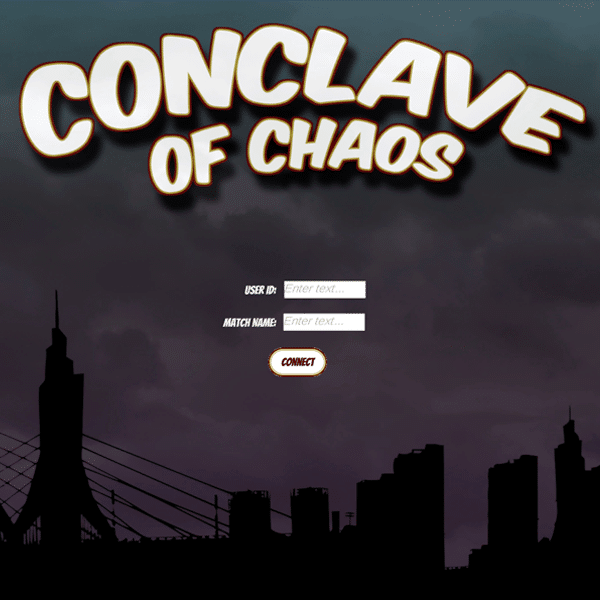
Conclave of Chaos is a two-player (or two-team) game that blends cooperation and competition, forcing players to balance group goals against personal objectives. The two players are supervillains collaborating on a joint project assigned by the leader of the Root 66 Supervillain Consortium. Each villain receives a baseline monthly income plus or minus funds from one-time events. Every month, they decide how much of their funds to invest in the joint project and how much to spend on their own goals. Along the way, they encounter prisoner’s dilemma-style challenges that can reward or penalize their monthly income, depending on whether each villain cooperates or defects against the other villain. Investments in the joint project advance their progress toward winning the game (and staying out of jail), but money they keep expands their own glorious collection of nefarious tools and trophies. Players meet with their opponents after five rounds to discuss their progress on the joint effort and to negotiate a way forward. After ten rounds, the game ends and players are scored on accomplishment of the joint project, accomplishment of personal goals, and their behaviors related to cooperation or defection.

This game represents the challenges of coopetition, circumstances when people need to cooperate with their competitors. It embeds three rounds of the prisoner’s dilemma as monthly events in which each player or team chooses to cooperate or defect against the other player or team. Players must carefully consider whether their collaborator is trustworthy when making decisions about whether to cooperate or defect, and the game rewards players who devise a strategy to complete the group goals while also funding their own projects. The game play is simple, but the dynamics among teammates and between opponents can be complex as they try to assess the other’s likely actions and reactions, and they try to maximize their personal gain within the constraints of the coopetition.

Game Overview

Conclave of Chaos teaches core learning goals in decision-making, strategy, economics, policy analysis, team dynamics, leadership, and ethics. The supervillain theme and game play provide a memorable, accessible way for players to experience coopetition. This includes making their own decisions (solo or with a team) and responding to the competitor’s actions, as well as assessment of the other party’s reliability as a partner and strategies to increase the other’s cooperation. The game includes an example of a prisoner’s dilemma and results are reported with final scores, enabling detailed discussion of this classic decision scenario. The mid-point pause to meet with one’s opponent and negotiate a way forward provides an opportunity to repair broken trust and incentivize cooperation.

The game is designed to develop skills in:

Decision-making under uncertainty
Recognizing the tension between cooperation and competition
Navigating the prisoner’s dilemma
Conflict management and negotiation
Building trust and fostering collective action

The goal of the game is to complete the joint project, while also achieving as many personal objectives as possible. These two goals are in conflict, and one or both players over-focusing on personal goals will cause the joint project to fail. If the joint project fails badly enough, both players also fail all of their personal objectives.

The game was developed for college classrooms. It has been played in several master’s-level decision-making classes and would be a good fit for courses in organizational behavior, business and management, strategy, negotiation, economics, or social psychology. It could be equally useful for adult workshops or training in topics that pertain to social dynamics, collaboration, or project management. Leadership training in corporate settings could benefit from this game.

Assessment for this game includes quantitative measures within the game and qualitative lessons that players can apply to the real world.
Within the game, measures include a Personal Goal Score and a Teamwork Score for each player, as well as the Joint Venture Percent Funded value.
The game leads the players to experience a coopative scenario directly, and it is important that the players consider what their experience has taught them. After completion of the scenario, the game encourages the players to consider and discuss amongst themselves the following questions:
– What challenges did you encounter in balancing cooperation and self-interest?
– How did your rival’s behavior affect your decisions?
– How did you decide if you should trust the rival team to cooperate when short-term challenges arose?
– What approach did you take when you met your rival at the mid-year convention?
– Were you able to reach an agreement during the convention? What was the nature of the agreement?
– And did both teams follow through on that agreement? Why or why not?
In a group setting (such as a workshop or classroom), we include a facilitated debrief to discuss all of these issues as a group. In a less formal setting, guidance is given by a worksheet with discussion questions.
To formalize the assessment of take-away lessons in a classroom or workshop, we recommend a brief follow-up assignment asking the players:
– What key factors affected your success in the game?
– What is the most important principle you can draw from this experience to apply to the real world?

Game Specs

Game Engine
Operating System
Platform

Game Video

Play the video below to learn more about Conclave of Chaos