
Award Won!

Best Social Media Crowdsourcing Game
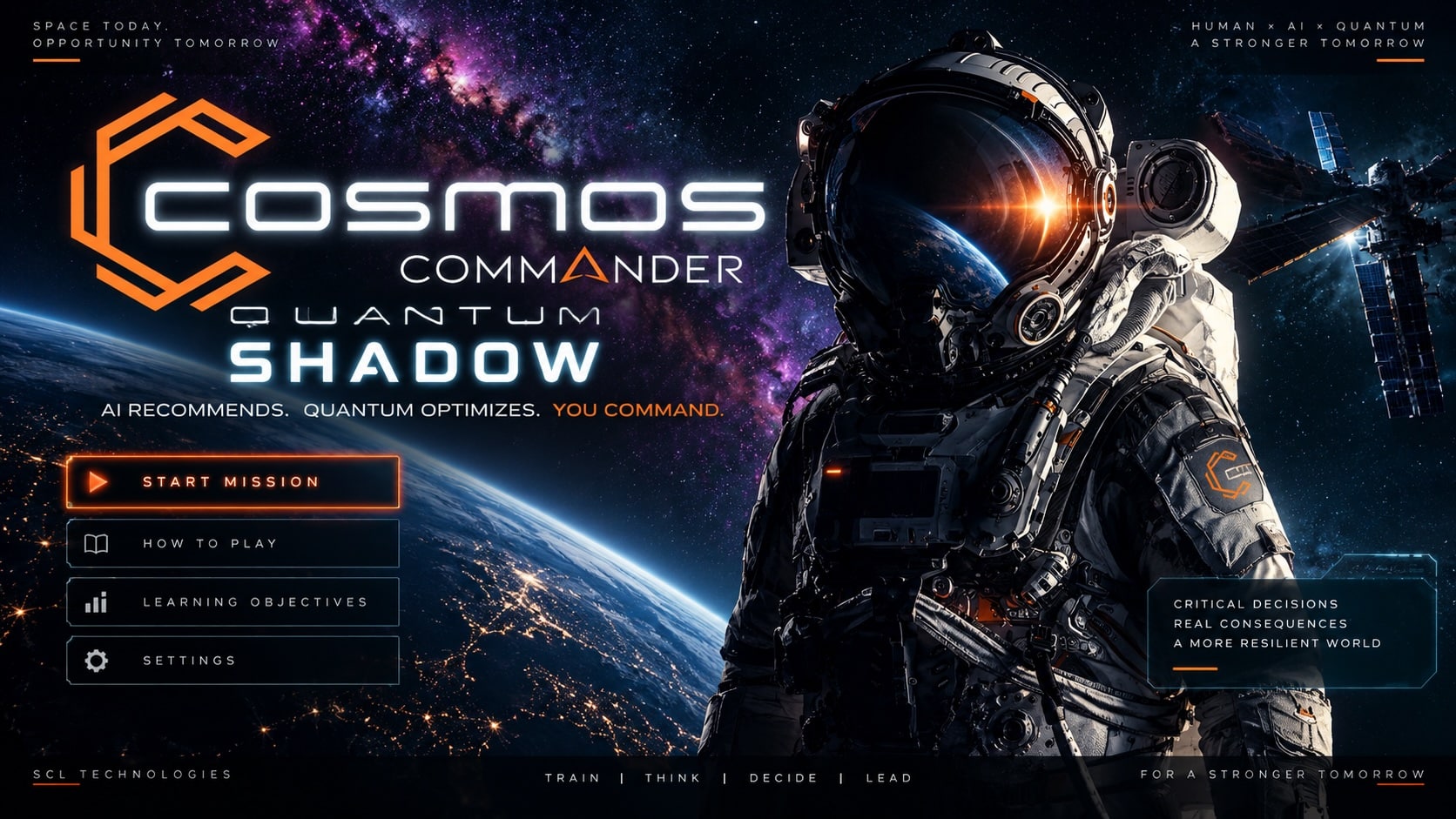
Cosmos Commander: Quantum Shadow

Organization:

Space Career Labs

Release Year:

Cosmos Commander: Quantum Shadow is a human-machine decision-making simulation that places players in command of a critical space network during five escalating operational crises. Working under time and resource constraints, players must interpret incomplete information, investigate anomalies, protect critical services, and make consequential command decisions.

Players are supported by ARIA, an AI decision-support system that identifies patterns, assesses evidence, and recommends actions, and QCORE, a quantum-inspired optimization system that evaluates competing strategies and operational tradeoffs. Neither system is presented as infallible. AI recommendations may be based on incomplete or compromised information, while an optimization may be computationally sound but based on inadequate objectives, assumptions, or constraints. The human commander retains final authority.

Across the campaign, players learn to determine when to trust machine recommendations, when to seek additional analysis, when to independently verify information, and when human judgment must challenge or reinterpret machine output. Decisions produce operational consequences and contribute to a post-mission Human × Machine Command Readiness Profile measuring Decision Quality, Systems Thinking, AI Trust Calibration, Optimization Interpretation, Verification Discipline, and Decision Velocity.

Rather than evaluating players solely on whether they achieve a successful outcome, Quantum Shadow examines how they reached their decisions. Post-mission review connects player actions, available evidence, machine recommendations, verification behavior, and consequences to help players distinguish good decision-making from a good outcome achieved by chance.

The simulation is designed to develop human-machine teaming, critical thinking, systems thinking, verification discipline, and responsible use of advanced decision-support technologies in complex, uncertain operational environments.

Game Overview

Cosmos Commander: Quantum Shadow develops decision-making skills for working with AI and advanced computational decision-support systems in complex, uncertain environments. Players learn to:

• Evaluate AI recommendations based on evidence quality, confidence, and available information rather than accepting or rejecting AI automatically.
• Interpret quantum-inspired optimization results and recognize that a computationally valid solution may still reflect incomplete objectives, assumptions, constraints, or data.
• Determine when independent verification is necessary before making consequential decisions.
• Recognize system dependencies and anticipate downstream consequences across interconnected services and assets.
• Balance decision speed with the need for additional evidence and analysis.
• Identify risks created by correlated, incomplete, or compromised information.
• Integrate human judgment, AI recommendations, computational optimization, and independent evidence into a defensible command decision.

The overarching learning objective is calibrated human-machine teaming: knowing when to trust machine support, when to question it, when to verify it, and how to retain effective human judgment and accountability.

he player’s goal is to maintain the operational integrity of a critical space network through five escalating crises while making timely, defensible decisions under uncertainty.

Players must determine how to use three sources of decision authority: human judgment, ARIA AI recommendations, and QCORE quantum-inspired optimization. They operate with limited time, incomplete information, and constrained opportunities for analysis and verification.

The challenge evolves across the campaign. Players encounter uncertain telemetry, competing emergency priorities, correlated information, cascading network failures, incomplete optimization objectives, and ultimately machine consensus based on compromised data.

Success requires more than keeping the constellation operational. Players must recognize system dependencies, evaluate the quality of evidence, determine when additional verification is warranted, interpret machine recommendations appropriately, and act before the decision window closes.

The central challenge is: Can the player make a good decision for the right reasons, rather than simply achieve a good outcome?

Cosmos Commander: Quantum Shadow is primarily intended for government, defense, and space-sector personnel and emerging professionals who must make decisions using AI-enabled and advanced computational decision-support systems.

Primary users include military and civilian personnel involved in space operations, command and control, mission planning, cybersecurity, intelligence, emergency operations, technical operations, and human-machine teaming. The simulation is also appropriate for professional military education, government workforce development, and advanced training environments exploring responsible human oversight of increasingly capable machine systems.

A secondary audience includes college students, advanced high school learners, and early-career professionals preparing for careers in aerospace, defense, cybersecurity, AI, data science, and other technology-intensive fields.

The simulation is designed for ages 12 and older, with the greatest training relevance for advanced secondary, postsecondary, professional, government, and defense learners.

Quantum Shadow uses a behavior-based assessment model that evaluates both mission outcomes and the process the player used to reach each decision.

Throughout five crises, the simulation records player behaviors including use of ARIA AI recommendations, requests for QCORE optimization, independent verification, evidence gathering, response to conflicting information, resource use, decision timing, and final command choices. Each crisis presents different conditions so that consistently following the AI, optimization system, or human instinct is not automatically rewarded.

Player behavior contributes to six assessment dimensions: Decision Quality, Systems Thinking, AI Trust Calibration, Optimization Interpretation, Verification Discipline, and Decision Velocity. Crisis-level performance contributes to a cumulative campaign assessment while preserving information about specific strengths and weaknesses.

A central feature of the assessment is the separation of decision quality from outcome quality. The simulation considers whether the player’s decision was defensible based on the evidence available at the time, not simply whether the resulting mission outcome was favorable. This allows the system to identify situations in which a player achieved a positive outcome through a weak decision process or experienced an unfavorable consequence despite making a reasonable evidence-based decision.

At campaign completion, results are synthesized into a Human × Machine Command Readiness Profile that provides an overall readiness score, dimension-level scores, a commander profile, strongest capability, development priority, key command behavior, and mission outcome. The Command Record provides an auditable history of player actions, and the post-mission decision review provides formative feedback connecting decisions to evidence, machine recommendations, verification behavior, and consequences.

Game Specs

Operating System
Platform

Game Video

Play the video below to learn more about Cosmos Commander: Quantum Shadow