
Award Won!
Best Social Media Crowdsourcing Game
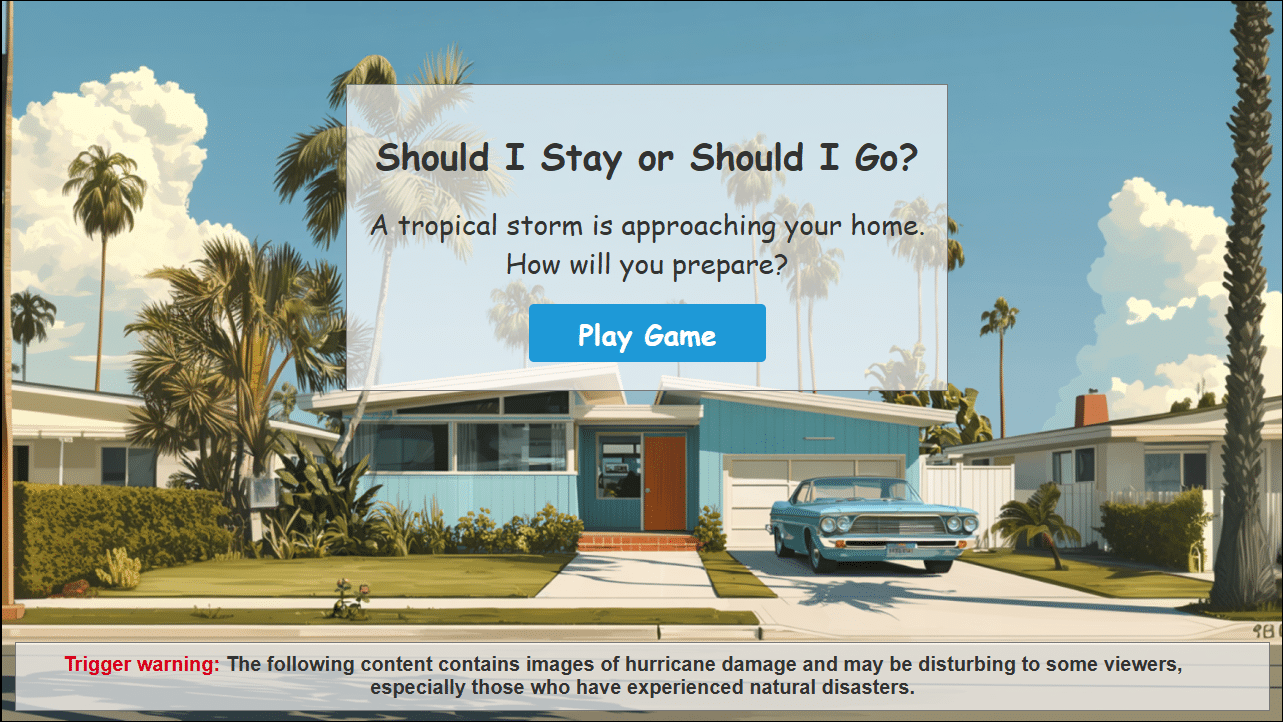
Should I Stay or Should I Go?
Bentley University
“Should I Stay or Should I Go?” is a browser-based, choose-your-own-adventure video game that teaches the general public key concepts and behaviors for protecting themselves from hurricanes. The setting is a fictional home near the ocean during the days leading up to the landfall of a hypothetical hurricane nearby. The game is organized into three levels, coinciding with three time periods associated with the storm: in Level 1, there is a tropical storm forecast to make landfall in approximately four days; in Level 2, the storm is upgraded to a Category 2 hurricane and forecast to arrive in 48 hours; in Level 3, the storm has made landfall as a Category 5 storm.
In each level, the player moves around the house and completes a series of challenges. Activities include watching news reports, assembling supplies, and answering questions about visualizations and incoming text alerts. Players can choose between actions that support preparations and actions that underestimate the potential danger of the situation. To proceed from level to level, players choose whether or not to evacuate. The game ends when the player chooses to evacuate, makes a choice resulting in death, or survives until the end of the storm.
There are four possible outcomes based on the player’s choices. Those who evacuate after Level 1 are “cautious”, as they may not have needed to leave yet, while those who evacuate after Level 2 are “golden” for heeding an evacuation order. Those who do not evacuate but manage to avoid other dangers are “lucky”, and finally, those who do not evacuate and make choices resulting in sudden death are “stubborn”. In all outcomes, players are given feedback about each choice and how it contributed to their outcome, and are invited to play again.
In addition to teaching players about hurricane literacy, the game also serves as a platform for researchers to evaluate user comprehension of alternative warnings and graphics in a simulated storm context. Researchers may swap in different graphics and alerts to examine their effectiveness at communicating risk and inspiring action.
